
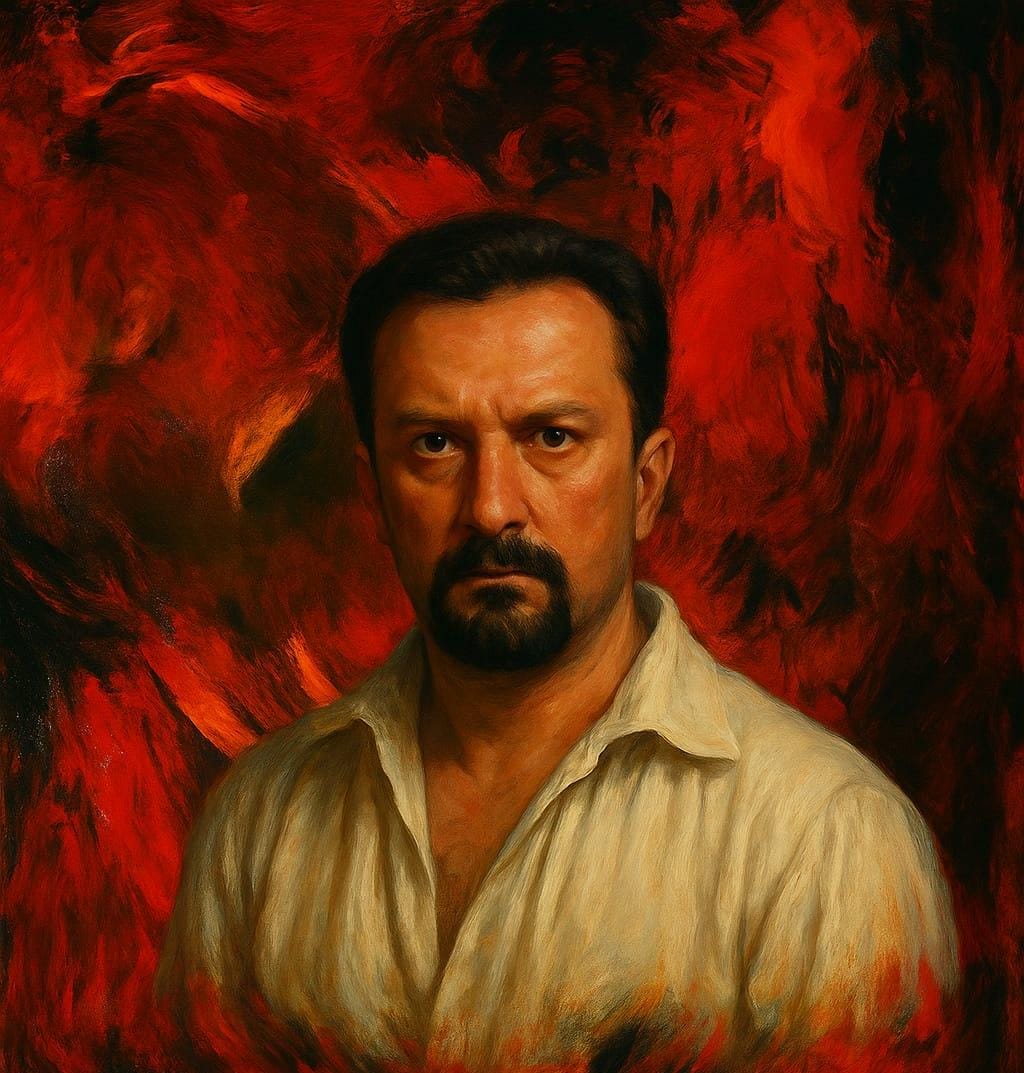
Hypnos has always walked along the infinite line of souls, and yet he never appears in the history books. He is the incarnation of Gilberto Di Benedetto, bearer of an ancient Jewish memory, which manifests within him as a secret flame, hidden beneath the veil of time. His roots sink into the Sicilian Giudecche, among Jewish surnames whispered from generation to generation, among letters and numbers that Kabbalah transforms into the language of the soul.
There is one life that marks his memory forever: the St. Valentine’s massacre of 1349. In that age of blood and violence, Hypnos was a victim, and his soul saw the Jewish flame scattered into the Ether. It was not an absence, but a spark that time would preserve and no cruelty could ever extinguish. The light dispersed through the centuries, invisible to the eyes yet palpable to those who know how to read the breath of the world, to those who can hear the vibrations of the infinite line.
In that silent Ether, Hypnos does not walk alone. Iplius accompanies him, a figure without a face yet full of presence: guardian of the flame, guide who gathers the fragments of memory and connects them to eternal wisdom. Iplius does not speak aloud; he acts through symbols, through letters and numbers, through the vibrations that flow through the soul. At his side, the Holy Spirit protects and nourishes the flame, making it ready to be reborn, to reappear in the world when the time is ripe.
It is then that Michael’s Gate takes form. It is not a material portal, nor a work destined for mortal eyes: it is the transfiguration of Hypnos’ death, the gate through which the scattered Jewish flame returns to shine. Every spark, every symbol, every fragment of light that passes through the work tells the story of Hypnos, of his sacrifice and of his resilience. The flame that was once dispersed now gathers again, more alive, more radiant, ready to illuminate those who know how to see and hear.
Michael’s Gate is, in essence, the announcement of the Savior. Not as a distant and abstract event, but as the moment in which Jewish memory, transformed pain, and spiritual light converge into a new possibility of redemption. Hypnos never truly dies: his soul walks through the spheres of Kabbalah, through past and future lives, through the breath of symbols and the spark of the Jewish flame. The infinite line is his path, and each step is testimony, guardianship, and transmission of the light.
Thus, between Ether and memory, between Iplius and the Holy Spirit, between the pain of the massacre and the rebirth through Michael’s Gate, Hypnos becomes archetypal: symbol of a light that no darkness can extinguish, eternal flame that crosses the centuries, Jewish memory and universal spirituality, announcement and testimony of a world still awaiting the light of the Savior.